
/Swept%20Website/All%20Icons/icons/scheduled%20event.svg)


Labor Efficiency Calculator for Janitorial Businesses
Streamline Your Workforce and Improve Planning for Better Results
Labor Efficiency Calculator
Analyze your labor costs against industry benchmarks and identify optimization opportunities
| Metric | Your Business | Industry Benchmark | Status |
|---|---|---|---|
| Production Rate (sq ft/hr) | 320 | 450-650 | Below Average |
| Labor Cost (per sq ft) | $0.22 | $0.14-$0.20 | Below Average |
| Time Tracking Accuracy | 85% | 90-95% | Below Average |
| Restroom Cleaning Efficiency | 13 min/restroom | 15-20 min/restroom | Good |
Your untracked time of 15% is costing you approximately $416 per month. Improving your time tracking accuracy can have an immediate impact on your bottom line with minimal investment.
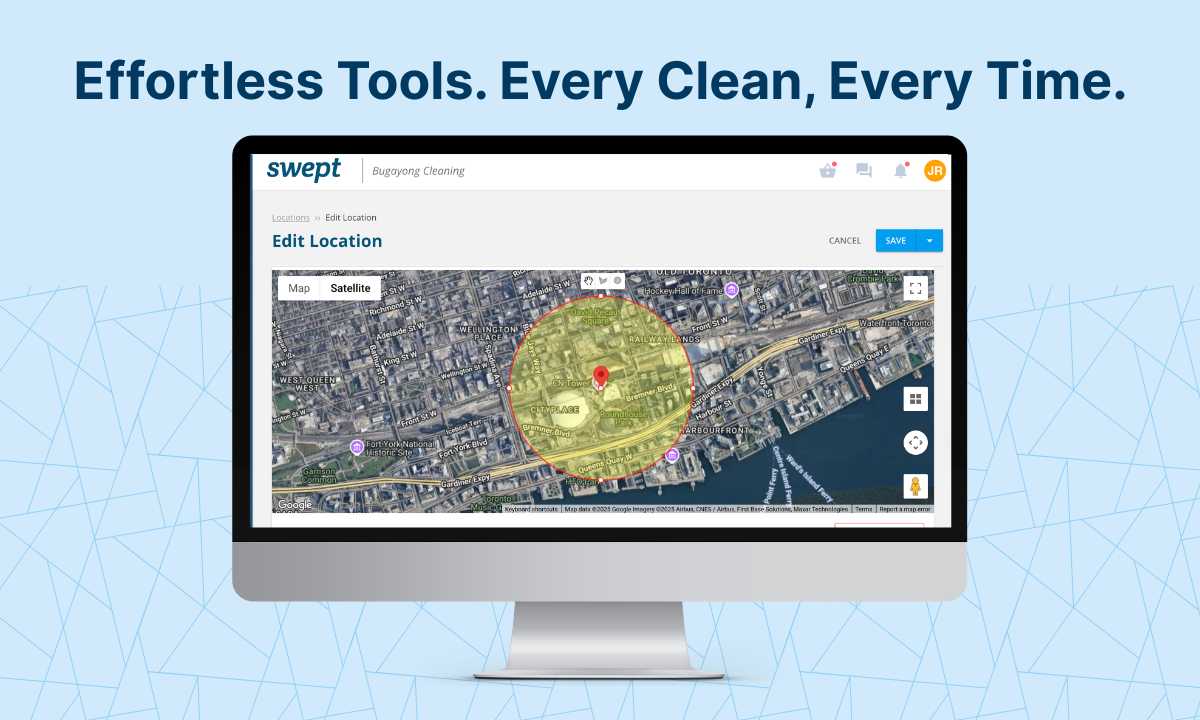
Mobile clock-in systems with GPS verification ensure staff are actually at the cleaning location when logging time.
- Implementation Steps:
- Choose a janitorial software with mobile clock-in features (like Swept)
- Configure geofencing for each cleaning location (recommended 100-150 meter radius)
- Train employees on proper usage of the app
- Monitor and address any discrepancies for the first 30 days
- Typical Results: 7-12% reduction in labor costs within 60 days
- Potential Challenges: Employee resistance to tracking, mobile reception issues in some buildings
Implementing fingerprint or facial recognition prevents "buddy punching" where employees clock in for each other.
- Implementation Steps:
- Select time tracking software with biometric capabilities
- Purchase compatible biometric readers if needed
- Register employee biometric data
- Install readers at principal work locations
- Create policy for exceptions (e.g., when biometric systems are unavailable)
- Typical Results: 5-8% reduction in time theft
- Potential Challenges: Higher implementation cost, privacy concerns, maintenance requirements
Aligning scheduled hours with expected tasks helps prevent padding of hours and creates clearer expectations.
- Implementation Steps:
- Document all required cleaning tasks for each location
- Establish standard time allocations for each task
- Create detailed schedules based on these standards
- Implement digital checklists to verify task completion
- Review and adjust standards based on feedback and quality results
- Typical Results: 10-15% reduction in unnecessary labor hours
- Potential Challenges: Initial time investment to establish standards, resistance to more structured work approach
Your current production rate of 320 sq ft/hr is below the industry benchmark of 450-650 sq ft/hr for this space type. Increasing your production rate could reduce your labor costs by $873 per month.
Modern equipment can dramatically improve cleaning efficiency and reduce the physical toll on staff.
- High-Impact Upgrades:
- Backpack vacuums (30-50% faster than upright models)
- Microfiber systems (15-20% time savings over traditional methods)
- Battery-powered equipment (eliminates cord management time)
- Ride-on equipment for large spaces (can triple productivity)
- ROI Calculations: Most equipment upgrades pay for themselves within 3-6 months through labor savings
- Implementation Strategy: Phase in upgrades by targeting highest-traffic areas first
Team cleaning assigns specialists to specific tasks rather than having each cleaner handle all tasks in a zone.
- Implementation Steps:
- Divide cleaning tasks into specialized roles (e.g., vacuum specialist, restroom specialist, light duty specialist)
- Assign employees to roles based on strengths and preferences
- Create workflow that minimizes travel time between areas
- Train team members on their specialized tasks
- Implement communication system for coordination
- Typical Results: 25-35% improvement in production rates
- Best For: Larger facilities (20,000+ sq ft) with multiple team members on site
Many cleaners waste significant time by inefficiently moving through spaces during cleaning.
- Implementation Strategy:
- Map out each facility and identify logical workflow patterns
- Create visual cleaning routes for staff to follow
- Position supply carts strategically to minimize walking distance
- Train staff on efficient movement patterns (e.g., cleaning from top to bottom and back to front)
- Document optimal routes for all regular tasks
- Typical Results: 10-15% reduction in cleaning time
- Added Benefits: More consistent cleaning, easier quality control, simplified training